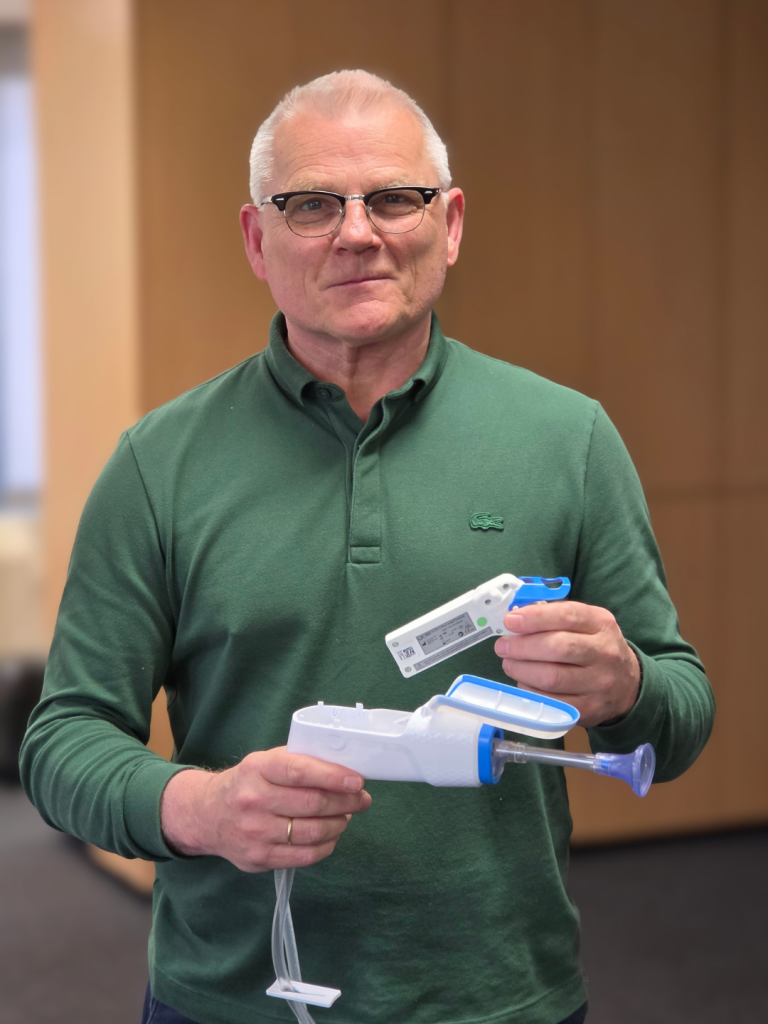
What sets BlueLavage® apart from other systems?
Ad Donkerlo: The biggest difference lies in the system’s design. With conventional single-use systems, everything is disposed of after each procedure, including electronics, drive units and batteries. That simply no longer makes sense today.
With BlueLavage®, all of the technology and the battery are housed in a removable drive unit. This unit can be reused several hundred times. Only the handpiece is replaced for each procedure. This prevents valuable materials, such as electronic components and rare raw materials, from being incinerated after just a single use.
This is also reflected in the environmental impact: Compared to conventional single-use systems, BlueLavage® generates about 65% fewer CO₂ emissions per procedure..
In addition, the plastic handpiece could be collected and processed into plastic pellets, which can then be used to manufacture new products. In this way, we are working step by step toward a circular economy solution.
Operational: What does this mean for logistics and availability in hospitals?
Ad Donkerlo: Many systems are manufactured in Asia. The BlueLavage® is manufactured in Germany. This offers two key advantages. First, transportation distances are significantly shorter, which directly contributes to lower CO₂ emissions. Second, there is less dependence on geopolitical developments and disruptions in supply chains. This ensures greater supply security.
In addition, the packaging is more compact. We save about 30 to 40 percent in volume. This not only reduces transportation costs but also the amount of storage space needed at the hospital.
Operational: What has been your experience with users in practice?
Ad Donkerlo: Users have responded very positively to the system's intuitive operation. The irrigation pressure is consistent and reliable, and the system fits comfortably in the hand. For the surgical team, very little actually changes—and that is exactly the intention.
We’re also hearing feedback that many people appreciate now having a sustainable alternative that is both practical and reliable. Sustainability has become an important issue in hospitals—not only at the management level, but especially in day-to-day clinical practice.
Operational: Could you elaborate on that?
Ad: Of course. A good example is the blue Transfer-Shield. It is made from recycled surgical materials, such as surgical gowns and drapes. These materials are processed into granules by our partner GreenCycl and reused. The drive unit is also collected after 200 uses and either recycled or remanufactured.
Operational: Where do you see your organization in this context?
Ad: For us, this is not just a single product launch, but a strategic direction for our company. We want to use raw materials more responsibly and support our customers in achieving their sustainability goals.
We are also supported in this by our membership in the Asker Healthcare Group, where sustainability plays an important role. Since becoming part of the group, we have been taking an even more critical look at our product line and its impact.
The environmental impact of the operating room is significant. It is precisely there that relatively simple decisions can make a noticeable difference. BlueLavage® is a good example of this.
In addition, it is important to us to promote awareness of sustainability beyond individual products. That is why, on Friday, November 20,we are hosting the second edition of the Nurse Day featuring renowned speakers from the fields of orthopedics and sustainability in the operating room. The goal is to share knowledge, inspire participants, and work together to determine how sustainability can be integrated into everyday clinical practice.